Showing posts with label 7 Days of Milk Kefir Growth. Show all posts

Monday, February 28, 2011

Day 7

The addition of more milk resulted in a slightly less acidic fermented kefir today.  Different from yesterday are a few factors.  First of all, I used 16 oz of milk vs. 12 oz of milk.  Also, I was able to use the fine mesh strainer for this batch as well.  This prevented any clumps containing curd / kefir grains from entering into the batch, unlike yesterdays.

This means that this batch fermented slightly slower than the previous one.  I also kept the temperature of the room between 60-63 degrees F.  Although liquid whey did form on the bottom in large quantities, there was a less uniform separation throughout. 

The curd on top was also very creamy in today's batch vs. yesterdays, which was rather dry in texture.  As I scooped a spoon through the curd, whey immediately filled the gaps where the curd had been.  By this point, the kefir has been able to greatly ferment the 16 oz of milk. 

After straining off the newest batch of milk, I was still unsatisfied with the smell.  HOWEVER, as the batches were fermenting prior to curd / whey separation, the aroma did have the illusion of yogurt again.  It wasn't until I removed the covering at the second 24-hour mark, that I noticed it still wasn't the aroma I am waiting for. 

The curd / kefir grains that remained in the strainer after removing the milk, were breifly rinsed with fresh milk.  I did this by leaving them in the strainer and poured a cup of fresh milk over them.  Then I returned them to a clean jar and added only 8 oz of milk.  I wont be trying to wait exactly 24 hours any more, as I will be consuming the kefir from here on out according to taste and texture.  I will try various stages of fermentation and keep you posted.  My immediate goals are to make the grains odorless to semi-sweet.  I will be using less milk to better control the process without wasting anything in the mean time.

After straining the last batch, I added about 4-5 dashes of ground cinnamon and gently swirled the jar.  I will wait 12 - 24 hours for this batch, while periodically checking on it as it ferments.  Once the process is down, and I am getting the aroma and texture I desire, I will purchase some bottles and different small neck jars with corked airlocks.

Sunday, February 27, 2011

Day 6 (Complete Curd & Whey Separation)

Here's a photo of the curd and whey separation on Day 6.  The night before, the whey had been accumulating on top and the curd on the bottom.  When I woke up this morning however, I discovered that the curd had finally floated to the top.  This batch was pretty thick still yesterday and wasn't finely strained before fermenting for the second 24 hours period.

Because of this, tiny bits of curd / kefir grains made their way into the batch.  The image shows that the process is definitely working now.  The only problem I have is the actual smell of the kefir and the curd / whey.  I had been using one brand of store bought milk when I started the process and switched when I ran low.  I had wanted to buy some milk in glass containers to reuse when I visit the raw milk farm.  I thought the milk in here would be just fine.  It wasn't.  I went to take a sip with something I was eating and almost threw up. 

Some people may not notice taste variations in their milk, but this was absurd.  I usually avoid Crowley milk because of this, but this was Byrne Dairy.  The weird thing is that I purchased another gallon of Byrne Dairy today and it is perfectly fine.  No distinctively bothersome odors as the glass approaches your face.  In fact, today's milk tasted great!  Although I'm only buying from the store until I'm ready to introduce the grains to Raw again.

So long story short, the milk I used the last few days has given the Kefir a strange smell.  Not appealing to me anyways, I just felt like I was drinking drugged cow milk mixed with blood and puss.  Since the grains are doing their job well, I fed them the new milk I purchased today.  The one WITHOUT any off smells to it.

HOWEVER...Because I was VERY curious what it may taste like.  I dipped a spoon into it.  I thought it would act like whipped cream and lend itself to an easy gentle pouring onto my spoon.  Nope, it was more like cream cheese instead.  I decided to pour the liquid whey off from the jar through a fine mesh strainer as the curd seemed to stay separated on top.  Then I scooped out the curd and put it into a small cup.  The curd didn't have too much of a taste.  I added some flavoring to give it a try.

After mixing a garlic & herb blend to it I gave it a try.  It was surprisingly good.  It needed flavoring for sure but it was something I could definitely eat again.  It was like a very dry cream cheese.  Or, if crumbled feta cheese was softer and more aerated, that's what it would be like.  It spread easy, but was rather dry.  I could have added liquid to make it creamy, but I didn't mind the consistency at all.  It was nice.  Although I do miss the overpowering yogurt scent I had created a few days earlier with a different brand of milk.  My hope is that after the yeasts readjust again, that almost bitter taste / smell will disappear.

After trying out the curd with moderate satisfaction, I also indulged in the whey liquid.  It's difficult to describe the taste of it at this point.  I can't say vinigery, as that doesn't do it justice.  I'd say bitter, or strong, but those don't say much either.  So until I can properly describe how it taste, I will say it's not worthy of consumption at this point.  I did however attempt to drink a bit of it.  I added some cranberry juice to a cup and tried to take it down.  It was difficult and I didn't get very far.  I believe I will discard that portion for now but I will save and finish the garlic curd spread for sure.

I also think that I may begin to lessen the fermentation time.  I have been doing a standard 24 hours with the grains and 24 hours without.  This may be too much now.  On the plus side, the 16 oz I used yesterday seems to have been a good amount for the grains.  It was still mostly liquid and strained easily.  First I strained it through a pasta strainer (large hole) and then I strained the liquid a second time through the fine mesh to get any extra clumps out. 

You'll notice that from day 3 to day 4 a very large increase in kefir grains / curds took place in the first fermentation jar.  Then they clumped together more losing more and more each consecutive day. 

I will try not to interrupt them at this point by separating them from any attached curd.  I will try and wait until they have grown considerably to do this.


Back on the shelf for yet another day.  Hoping that the yogurt smell will return soon.  The milk I used was a bad idea.  I thought that because I didn't want to drink it that my grains might.  I don't think it was their cup of tea either.  Lesson learned, don't switch your milk unless you have to, and don't feed the grains milk that smells like S%#t.

Saturday, February 26, 2011

Day 5 (Need More Milk)

Again, the kefir fermented the 4th Batch of milk rather quickly in only 24 hours.  I had to stir the milk very well to make it liquid enough to strain.  I am no longer able to use the fine mesh strainer.  I will save that for water kefir grains.

As I need to go buy a larger diameter strainer for the milk kefir, I had to find something else.  Luckily we have several pasta strainers at the house.  They have a much larger hole opening but it seemed to work just fine.


It strained rather quickly as well.  Here is what remained after straining.  The clump seems to be doing well so far.  It doesn't smell sweet and aromatic like the batch that sat an extra 24 hours post kefir grain fermentation.

Some people will directly consume the liquid from the grains at 24 hours.  This isn't for me.  I prefer the kefir to have a sweet smell and a higher nutrition content.  Leaving the fermented milk to sit for at least another 24 hours at room temperature should do the trick.
As the milk had become very clumpy again in such a short period of time, I decided to up it again.  This time I refilled the jar with 16 oz of milk.

You can see just above the kefir level on the jar with the green cover that just from walking downstairs with it, it had stuck to the sides.  It was thick and had begun to separate a bit on top with whey liquid settling.

For reference (Blue cloth) contains the milk kefir grains with a fresh batch of milk.  (Green cloth) contains the milk kefir w/o grains for their second day of fermenting.

Friday, February 25, 2011

Day 4 (Beginning to Work)

Day 4 seems to have produced some promising results.  Batch number 2 at the 48 hour mark had the most amazing smell to it.  It was like a very sweet yogurt.  It reminded me of the Trix Yogurt or the Gogurt I used to eat growing up.  The smell was amazing.

Some interesting things have begun to occur with this batch as well.  For starters, BOTH jars had fermented to a point of becoming clumpy and very difficult to strain.


Here is a photo of Batch 2 after 48 hours of fermentation (24 hours with kefir grains & 24 hours without the grains).  Notice the thick layer on top.  The smell of this was fantastic.  It almost made me want to consume it.  But allas, I won't be doing that for a while yet.


Here is a closer view of Batch 2.  The entire thing was creamy throughout.  The top layer is more of a cream color compared the to rest which still maintained it's milk appearance in color.

It looked and smelled exactly like yogurt.  This is a sign that the kefir grains are gaining in both strength and numbers.  This also tells me that I will need to increase the amount of milk I have been providing for them to feed off.


Became rather surprised when I attempted to strain the milk from the jar with the kefir in it.  As you can see from the photo, this wasn't easy.  The entire jar had the consistency of very small curd cottage cheese, only a little runnier.  This presented a dilemma for me.  I needed to strain as much of it as I could so that I only had the clumpy mixture left over to add back.

To solve this problem, I used an additional 4 oz of milk to help with the straining.  First I poured the milk into the jar with the kefir and mixed it well.  Then I poured small amounts of the fluid into the strainer and moved it around to drain off as much liquid as possible.  Then I rinsed and dried the strainer after each pour.

Once I had strained as much liquid from the grains as I could, I cleaned out the jar they had been in previously and added the contents back.  What your seeing in this photo isn't an overgrowth of milk kefir grains from day 3 to day 4 alone.  It is also curd, which has fermented and attached itself to the existing kefir grains.

The grains themselves are still fairly small at this time and I don't want to interrupt the process too much.  I drained off all the liquid I could and put the entire contents back into the jar instead of trying to break it apart and separate it into curd and kefir grains.

Either way, they are working very hard to have completely thickened the milk in only 24 hours time.  Some changes now need to be made.

Here is what the contents now look like after they have been added back to the jar.  Looks just like cottage cheese to me.


After returning the kefir grains to a clean jar, I measured out 8 oz of milk.  This is double what I have been using.  I then measured out an additional 4 oz for a total of 12 oz added back to the kefir.  This will hopefully give me a slight buffer and prevent such overgrowth of curd from happening in the first jar.  I would love to see that happening in the second jar but not the jar with the milk kefir grains present.

As I had to add more milk to the contents of batch 3 to make it liquid enough to even pour, I disposed of the contents afterward.

I could have allowed them to ferment in the second jar with the addition of 4 oz fresh cold milk but decided at this point I would focus on the newest batch instead.

We can see now that the process is beginning to speed up.  I want to see now how the grains will perform with 12 oz of milk instead of only 4 oz.

My hope is that the first jar will remain fluid enough to pour nicely into the second jar for more fermentation after 24 hours.  I would like to separate some of the curd from the kefir grains fairly soon.  Hopefully the extra milk will help this to happen.  I have been agitating the grains and milk 2X during fermentation.  Once at the 8 hour mark and again once upon waking in the morning.

Thursday, February 24, 2011

Milk Kefir Growth (Days 1 - 7) Images


Day 3 (Clean 2nd Fermentation Jar)

No curd or whey separation so far.  It can take several day or more for the whey to begin to separate between the 24 and 48 hour time frame. 

Once the milk kefir grains have grown more in size, they will have a stronger effect on the milk during the 1st 24 hours.

One of my fears was the notorious smell of rotting milk.  So far there hasn't been any offensive odors produced. 

I even took a close smell of the milk that had fermented for 48 hours before dumping it down the drain.  The only smell it gave off was that of Elmer's glue with an ever so subtle sour aroma.

Once the milk had been dumped into the sink, I noticed the beginnings of milk build up around the top of the 4 oz marker.  I also noticed that as I was dumping the milk, a thin film had started to develop on the bottom of the jar below the milk.

To rinse the jar out I simply used a small drop of joy, a scrub brush and some hot water.  As long as the jar is rinsed completely and then dried completely, neither the joy or tap water will have any negative effects on the fermentation process.  I will be cleaning the 2nd fermentation jar (The one without the kefir grains) on a daily basis prior to introducing the next batch.

Once the 2nd jar had been cleaned and dried, I was ready to again transfer the milk containing the kefir grains.  Before the grains are strained, the milk and grains are gently swirled until the milk has been properly mixed throughout.
Here is an image of the grains that made it onto the strainer during the pour.  There again appears to be a lot more of them today that yesterday.  They seem to be doing well so far. 

A large portion of them still remain in the jar during the pour.  Several also cling to the side of the jar during the process.
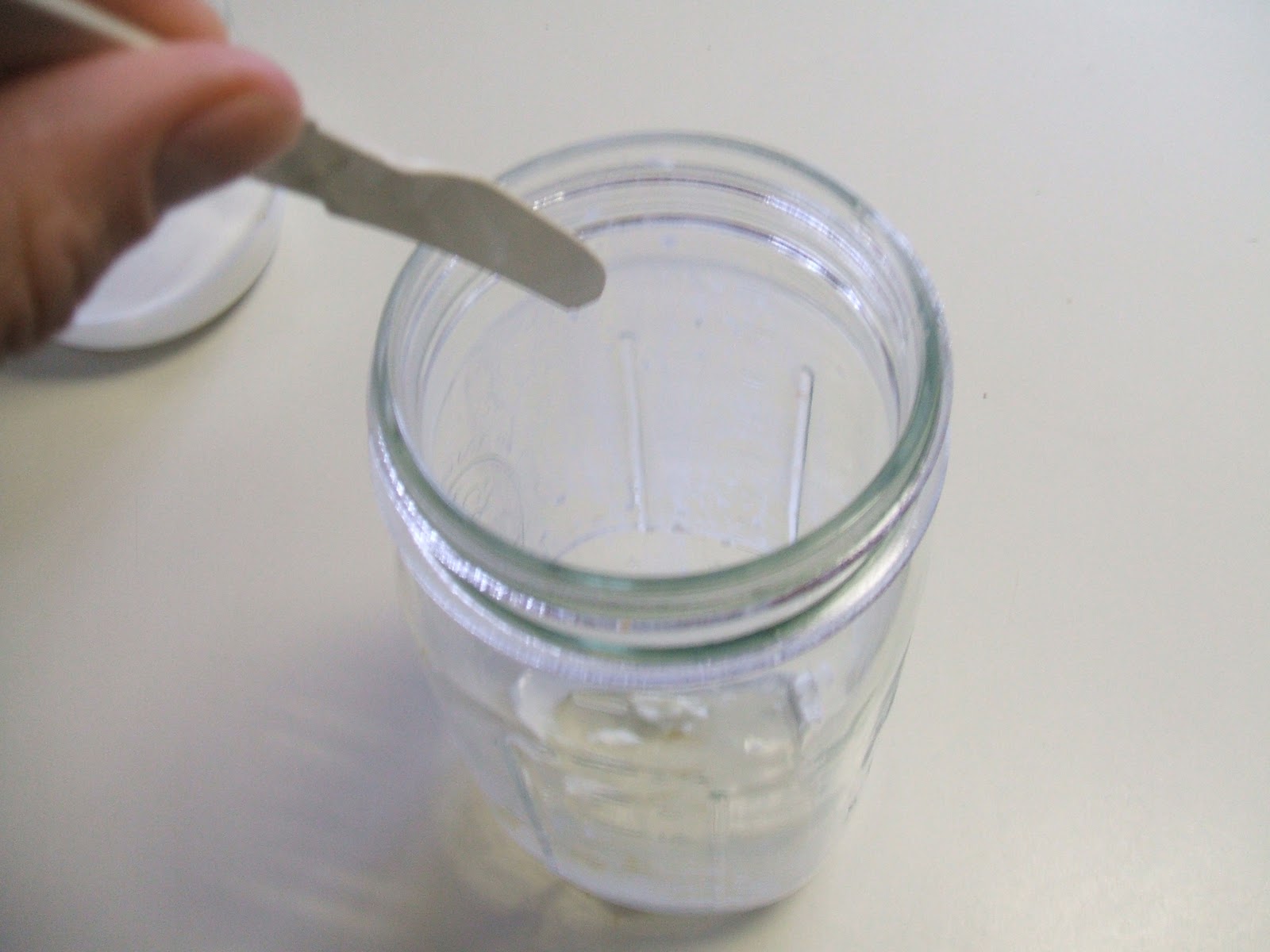
To get any of the extra kefir grains that make their way to the side of the jar, I simply use a plastic knife to push them back down to the bottom.  I have not cleaned this jar yet as I want to allow the kefir to grow more before I do so.  The small amount of milk stains at the 4 oz level on this jar aren't bothering me yet.  Cleaning the jar out to replace the grains in at this time would be more of a visual cleaning that one with a purpose.


Here is an image of the kefir grains on Day 3.  You can still see a small amount of milk remaining in the jar each time.  A few of the grains have begun to clump together into thicker groupings.


Back on the shelf until tomorrow.  I hope to start seeing some curd and whey separation by the end of the week.  Only time will tell... 

Wednesday, February 23, 2011

Milk Kefir Growth (Days 1 - 7)

Two Images (Left) & (Right)
Left Image (Contains 2 jars - Left Jar & Right Jar)
Left Jar - Contains milk that has fermented for 24 hours in kefir grains from the jar to it's right.  This milk has been strained and should be void of any remaining milk kefir grains.  This jar will remain undisturbed for another 24 hours.
Right Jar - Contains fresh milk and existing milk kefir grains.  This jar will be agitated in some way to ensure even distribution of grains and a more even feeding.

Right Image (Contains 2 Jars - Left Jar & Right Jar)
Left Jar - Contains milk that has fermented for an additional 24 hours without any kefir grains present.  This will equate to a total of 48 hours of kefir fermentation.  The contents of this jar are not touched in any way shape of form during this second 24 hour fermentation period.  This allows us to see any curd and whey separation without interfering with it during the process.  When the contents begin to separate after the 2nd 24 hours period, they are ready to be consumed. 
Right Jar - Contains milk that has fermented for 24 hours WITH milk kefir grains.

Day 1 - Baby milk kefir grains arrive by mail.  4 oz whole pasteurized  cows milk added to jar with grains.  Jar agitated at 8 hour mark and 19 hour mark.  Left to ferment for 24 hours between 61-65 degrees F.


Day 2 & 3 - 1st batch of milk is strained into an additional jar to ferment without grains for another 24 hours.  Another 4 oz of whole pasteurized cows milk is added to first jar (Right Jar) to ferment for 24 hours.  No separation in second jar after second 24 hours fermentation.

Day 3 & 4 - 2nd batch of milk is strained into an additional jar to ferment without grains for another 24 hours.  Another 4 oz of whole pasteurized cows milk is added to first jar (Right Jar) to ferment for 24 hours.  After 24 hours, both jars had fermented very well.  More milk will now need to be added.  Batch 3 looked like cottage cheese after only 24 hours.  Batch 2 looked and smelled like yogurt, amazing.

 Day 4 & 5 - Batch 3 was disposed of as it was too thick to strain off.  In order to remove the majority of the contents, fresh milk was added and mixed well then strained.  A lot of curd had combined with the kefir grains from this batch.  I decided to add 12 oz of milk for batch 4.   After 24 hours with 12 oz of milk the fermentation was tremendous.  I will be upping the milk to 16 oz.


Day 5 & 6 - The kefir had to be strained through a regular pasta strainer today as it was too thick for the fine mesh strainer.  The grains seem to be doing well and growing fairly quickly.  16 oz of milk is now being used for Batch number 5.

Day 6 & 7 - I made the mistake of changing milk recently to a type that had an off smell and taste to it.  I didn't want to drink it, so I fed it to the grains instead.  Now the smell had gone from yogurt to a bitter unpalatable mixture.  So for Batch 6 I switched it to something without much of a smell or and off taste.  Hopefully this will solve the yeast problem.